
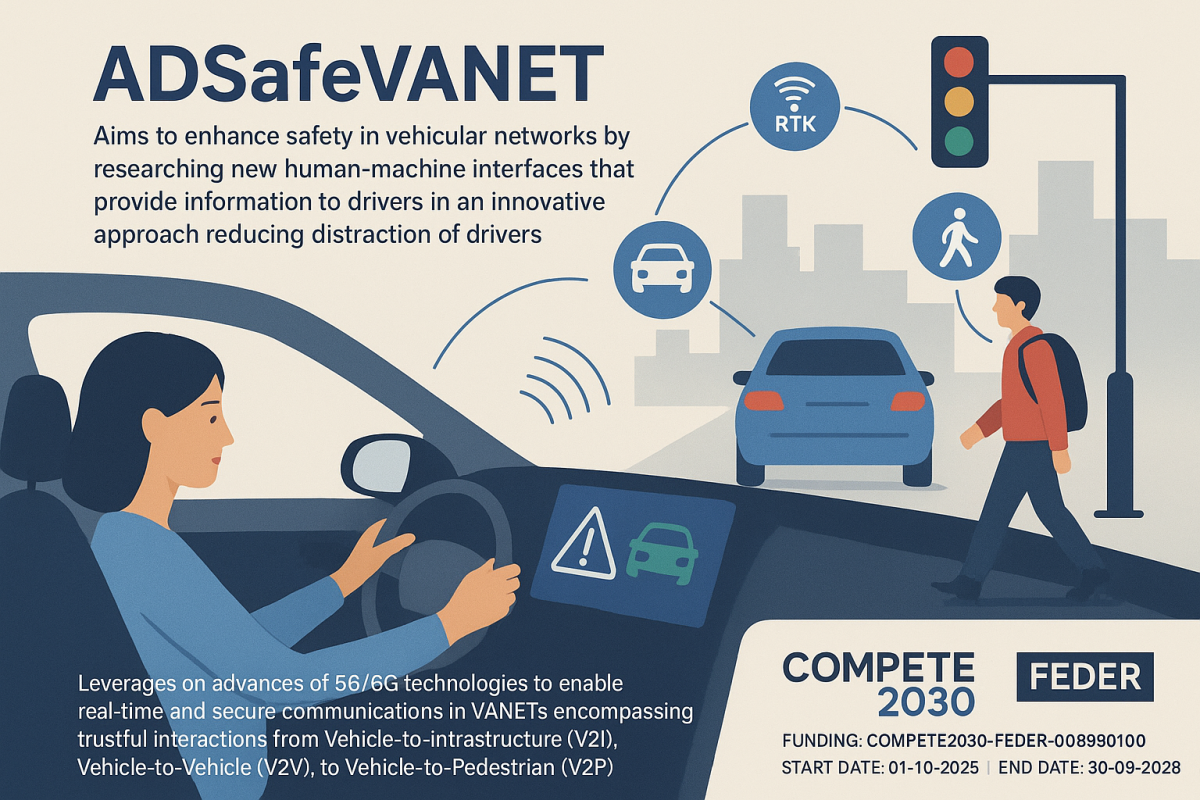
Augmented Driving for Safer Vehicular Networks
ADSafeVANET aims to enhance the safety in vehicular networks by researching new human machine interfaces that provide information to drivers in an innovative approach reducing the distraction of drivers. ADSafeVANET leverages on the advances of 5G/6G technologies to enable real-time and secure communications in VANETs encompassing trustful interactions from Vehicle-to-Infrastructure (V2I), Vehicle-to-Vehicle (V2V), to Vehicle-to-Pedestrian (V2P).
The VRLab is responsible for investigating in-car human-machine interfaces (HMIs) aimed at improving driver situational awareness during overtaking and pedestrian interactions without causing distraction, using virtual reality as the main testing environment. Following a user-centred design approach, candidate HMIs will be developed through iterative prototyping and feedback, and then integrated into an adapted VR driving simulator equipped with simulated sensors and VANET communications. The resulting interfaces will be evaluated through VR-based driving exercises using established usability and automotive HMI standards to assess effectiveness, safety, user experience, and suitability during realistic driving conditions.
Open positions
Masters student position
One masters student position available:
The objective of this scholarship is to support the research activities of the ADSafeVANET project, specifically Task 2, which focuses on enhancing road safety through human-centered augmented driving technologies. The scholarship holder will contribute to the design and evaluation of in-vehicle human–machine interfaces for connected vehicles, with particular emphasis on improving drivers’ situational awareness in safety-critical scenarios such as overtaking maneuvers and pedestrian crossings in low-visibility conditions.
Workplan: The work will begin with a review of relevant literature and project documentation related to human-centered design in automotive contexts, connected vehicles, and situational awareness, as well as an analysis of the use cases addressed in ADSafeVANET Task 2. This phase will also include the study of applicable standards for in-vehicle information presentation to inform design decisions.
Based on this analysis, the scholarship holder will contribute to the design of multimodal in-vehicle interface concepts addressing overtaking and pedestrian crossing scenarios. These concepts will be iteratively refined and prototyped using digital design tools and integrated into a simulated driving environment. Finally, the work will focus on the evaluation of the proposed interfaces through controlled laboratory studies, including VR-based simulations, to assess usability, user experience, and potential distraction effects. The results will be analyzed and documented, generating design insights and technical contributions that feed directly into the deliverables of ADSafeVANET Task 2.
Deadline: 05/05/2026
Apply: https://app-4.apply.uc.pt/manage/procedures/xg6zvpl5b14ltcwj
Project details
Participating Institutions in the Project:
- University of Coimbra (DEI/CISUC)
- University of Aveiro
Reference: COMPETE2030-FEDER-00888100
Funding Program: COMPETE2030-FEDER
Execution period: 01/10/2025 to 30/09/2028
