
We are thrilled to share that the Virtual Reality Lab (VRLab) will have a strong presence at the 25th IFIP International Conference on Entertainment Computing (ICEC 2026) in Paris this October.
This year, our team is bringing five accepted contributions, spanning Work-in-Progress research papers and live Interactive Entertainment Showcase demonstrations. Our works explore a broad spectrum of immersive experiences — from tangible heritage storytelling and serious games for industrial expertise to novel, hands-free foot interactions in VR.
Exploring Symbolic Cultural Heritage Through XR: A Case Study with Emblematic Art
Work in Progress
Authors: Jorge Antunes, Jorge Cardoso, Filipa Medeiros
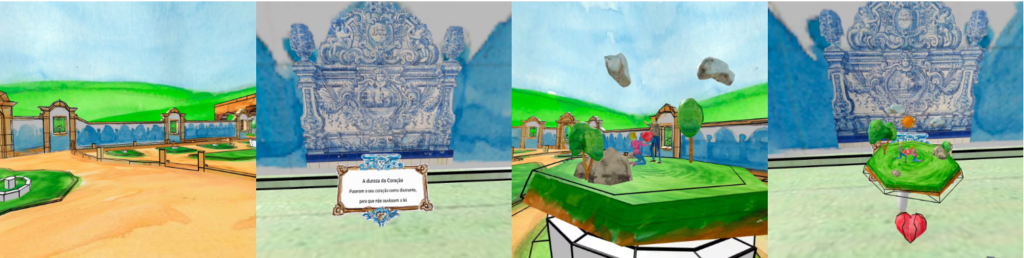
Emblematic art combines symbolic imagery and textual elements to convey complex moral and religious meanings, but interpreting these historical artworks can be challenging for contemporary audiences who lack context or Latin fluency. In this project, we explore how immersive XR can bridge this gap at the Bissaya Barreto House Museum garden in Coimbra. We developed a VR application that lets users explore a virtual reconstruction of the garden and a mobile AR application that augments physical tile panels on-site. Through animated visualizations and narrated explanations, both applications make these symbolic artworks accessible and engaging. Preliminary user evaluations showed that visitors strongly valued the interactive narrative features and freedom to explore, while offering key design insights on how to clearly communicate interactive elements in cultural settings.
The Lloyd’s Register Tangible VR Book: A Playful Mixed-Reality Interface for Exploring Maritime Heritage
Interactive Entertainment Showcase
Authors: Marcelo Coelho, Jorge Cardoso
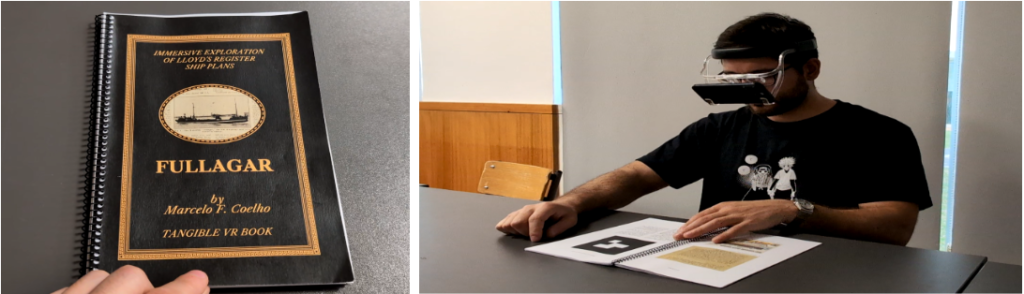
Physical books offer a tactile familiarity that digital screens often struggle to match. This showcase presents a playful mixed-reality interface that couples a physical book with a smartphone-based VR setup to bring archival materials to life. By turning pages augmented with markers, users trigger spatially distributed digital media—including 3D models, historical imagery, narration, and full 360° environments—arranged in spatial planes around them. Centered around the history of the Fullagar (the world’s first fully welded ship), this tangible system demonstrates how low-cost mixed reality can transform static historical archives into physically grounded, interactive narratives ideal for public and educational exhibits.
https://vrlab.dei.uc.pt/lrvrbook
Reinventing Industrial Quality Inspection through XR
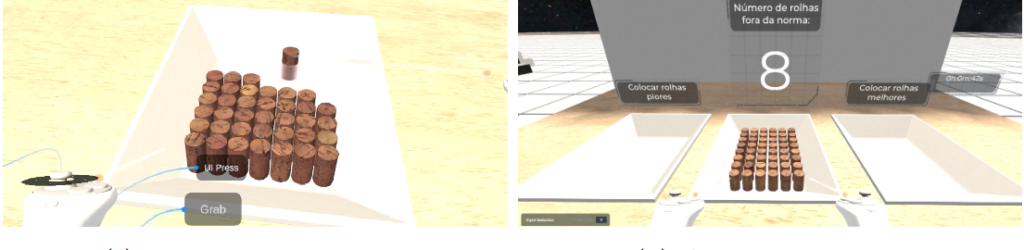
Manual cork quality inspection relies heavily on fine-grained perceptual expertise built over years of practice, making traditional workplace training difficult to standardize and slow to deliver. To address this, our team developed a comprehensive XR serious game platform to transform industrial training into a structured, engaging experience. We are bringing two complementary presentations on this initiative to ICEC 2026:
- XR Cork Trainer: An Interactive XR Experience for Cork Quality Inspection
Interactive Entertainment Showcase
Authors: João Perdiz, Jorge Cardoso, Tiago Ventura, Marcos de Souza Oliveira, Armin Gharibi, André Perrota, Licinio Roque
Set in a terraced gameplay arena where vertical progression reflects increasing task abstraction—moving from basic outlier detection up to complex system-level grading—this demo lets conference attendees experience our interactive training environment firsthand. Featuring diegetic industrial controls and high-fidelity 3D cork samples, it illustrates how interactive entertainment can revitalize traditional vocations and accelerate perceptual learning. - Designing an XR Serious Game for Cork Quality Inspection: Requirements, Prototype, and Lessons Learned
Work in Progress
Authors: João Perdiz, Jorge Cardoso, Tiago Ventura, Marcos de Souza Oliveira, Armin Gharibi, André Perrota, Licinio Roque
In this research paper, we dive deep into the design choices behind our prototype. We outline the process from initial requirement elicitation to the creation of seven targeted exercises using ludic, comparison-based mechanics. We also candidly discuss key engineering and design challenges encountered along the way—including asset visual fidelity, dataset constraints, and physical interaction limits—to inform future XR serious games built for complex perceptual training.
FootMenu: Foot-based Radial Menu Interaction for Navigation in 360° Virtual Tours

Work in Progress
Authors: Francisco Santiago, Jorge Cardoso
Hands-free interaction in virtual reality opens up exciting possibilities for multi-tasking and enhanced immersion. FootMenu is an open-source Unity component designed to test the feasibility and usability of foot-controlled radial menus in entertainment-oriented 360° virtual tours. We conducted an exploratory study comparing direct and indirect foot-menu interaction modes, evaluating user performance, error rates, and subjective workload. Our preliminary results highlight the distinct usability trade-offs between both foot-controlled variations, offering concrete design guidelines for researchers and creators looking to implement hands-free navigation techniques in immersive VR.
We look forward to connecting with the international entertainment computing community in Paris! Stay tuned for updates, photos, and presentation slides during the conference in October.